You rank first on Google and still get skipped in AI answers. That gap now decides which brands buyers hear about, and pricing for fixing it ranges from $250 to $2,000 a month.
This guide breaks down what an AI visibility service actually costs, what each Rankera tier covers across 20 to 350 target searches, how premium niches shift the price, and how those rates compare to typical alternatives. By the end, you will know which plan fits your search volume and whether the spend is worth it.
What Is Rankera? The Done-For-You AI Visibility Service
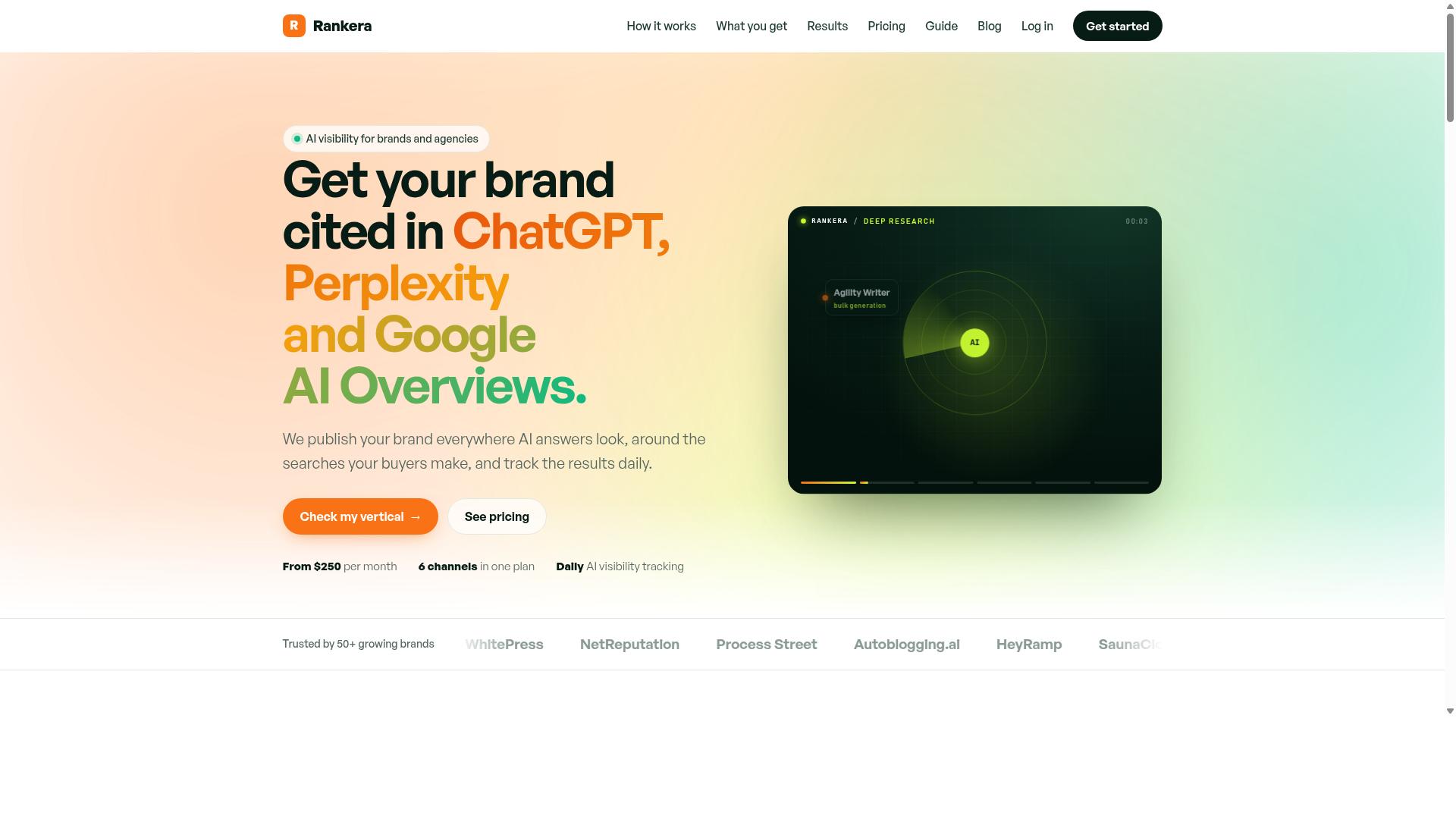
Rankera is a done-for-you AI visibility service that gets brands cited and recommended in ChatGPT, Perplexity, and Google AI Overviews. It publishes brand mentions across six channels each month around the searches buyers actually make, so the brand shows up in the sources AI systems read and quote.
This is not a self-serve tool. Rankera is a managed solution, which means clients do not pitch journalists, chase placements, or manage publishing schedules themselves. The team handles research, planning, and publishing on the client's behalf.
Rankera also tracks AI Overview mentions and Google rankings daily, giving clients a clear picture of how visible their brand is inside AI answers over time. The company states that ranking first no longer means being recommended, because AI answers name two or three brands and pick them from what other sources say. Rankera was built by the team behind Autoblogging.ai, and its process runs in four stages: research, plan, publish, and track.
Who Rankera Serves and Where It Works
Rankera serves brands, SaaS companies, service businesses, and agencies, including white-label partners, that want to improve their AI visibility. The service is a global online offering available worldwide, with content published in English across Google, Bing, YouTube, Medium, Instagram, and GitHub.
That mix of channels matters because AI systems pull recommendations from many corners of the web, not just a single search index. By spreading mentions across six channels, Rankera gives AI answers more places to find and reference a brand.
The audience spans both businesses that sell online across the country and local businesses serving a specific area. Common use cases include:
- Local businesses, including dental and medical clinics, law firms, roofing and HVAC contractors, real estate, recovery and treatment centres, coaches and consultants, and businesses with several locations
- Small businesses such as online shops, B2B service firms, independent software makers, one-person agencies, clinics, and trades
- Larger categories including SaaS companies, ecommerce brands, healthcare and clinics, hotels and hospitality, and contractors and home services
Agencies also make up a significant part of the client base. SEO and content agencies, digital PR and reputation firms, web design studios, and consultancies use Rankera, with white-label options available for those who want to deliver AI visibility results under their own brand.
Because the service runs online, location does not limit who can sign up. A single-location clinic and a national SaaS company follow the same core process: research the buyer searches and competitors, build a monthly roadmap the client can edit, publish across six channels with fast indexing, then track AI mentions and rankings every day. That consistency is what makes the model work for such a wide range of businesses.
What You Should Expect to Pay for an AI visibility service Like Rankera
When budgeting for an AI visibility service, expect monthly fees that typically range from a few hundred to several thousand dollars, depending on the scope and number of target searches. That spread is wide because "AI visibility" covers a lot of ground, from tracking a handful of prompts to monitoring brand mentions across multiple AI assistants and search surfaces.
The price you pay usually reflects three things: how many target searches or queries you want covered, how many channels or platforms are monitored, and whether the work is done-for-you or self-serve. A lean setup aimed at a small set of queries sits at the low end. A broad program that watches many prompts across several platforms lands at the high end.
For context, entry-level AI visibility services often start somewhere around $200 to $500 per month. These plans typically cover a limited number of tracked searches and a single channel, which suits solo founders or small teams testing the waters.
Mid-tier plans generally fall in the $500 to $1,500 per month range. At this level, you usually see more tracked queries, additional channels, and reporting that shows how your brand appears across different AI answers over time.
Comprehensive or enterprise-oriented plans can exceed $2,000 per month. These are built for organizations that need wide coverage, multiple stakeholders, and deeper tracking across many searches and platforms simultaneously.
One factor that catches buyers off guard is how the service charges. Some providers bill per placement, meaning you pay each time your brand gets mentioned or cited. Others require you to pitch or submit content for consideration, which adds hidden costs in time, labor, or both. A flat subscription with a clear scope is often easier to budget against than a per-placement model that scales unpredictably.
Another variable is whether the service is done-for-you or self-serve. Done-for-you options cost more because a team handles strategy and execution on your behalf. Self-serve tools cost less but put the work back on you.
Before committing, it helps to map your own needs against these tiers:
- Number of target searches: how many prompts or queries you want monitored
- Channels covered: one AI platform versus several
- Service model: done-for-you, self-serve, or a hybrid
- Billing structure: flat monthly fee versus per-placement charges
- Reporting depth: simple mention tracking versus trend analysis over time
A practical approach is to start with a smaller scope, confirm the service actually surfaces useful mentions for your brand, then expand. That keeps early cost expectations manageable and lets you scale spend only when the value is clear.
It also pays to ask providers directly about anything that could inflate your bill later. Questions worth raising include whether unused searches roll over, whether adding a channel triggers an upgrade, and whether there are setup or onboarding fees on top of the monthly rate. Getting these answers up front turns a vague quote into a real budget planning number.
Watch for the difference between a subscription tier and a usage-based charge. A subscription tier gives you a fixed monthly billing amount you can forecast. Usage-based pricing, including per-placement fees, can swing widely depending on how often your brand gets picked up, which makes it harder to plan around.
Annual plans sometimes lower the effective monthly cost compared with paying month to month. If a provider offers both, compare the total yearly outlay rather than just the headline monthly figure, since annual commitments trade flexibility for a lower rate.
Finally, weigh the fee against the return on investment you expect. AI visibility is still an emerging category, so the value comes down to whether tracked mentions translate into awareness, traffic, or leads for your business. A cheaper plan that misses your key searches is worth less than a pricier one that captures them.
Keep in mind that pricing in this space is not standardized the way mature SEO software categories are. Rank tracking and keyword research tools have had years to settle into predictable tiers. AI visibility is newer, so quotes vary more from provider to provider, and the same headline price can buy very different scopes.
That makes comparison shopping essential. Line up what each plan actually includes, not just the number at the bottom. Two services at the same monthly rate can differ sharply in tracked searches, channels, and reporting.
With that framework in mind, you can evaluate any specific provider's pricing against a realistic range rather than an arbitrary one. The next step is seeing how a given service structures its own tiers and what each one covers.
Rankera's Pricing: From $250 to $2,000 Per Month
Rankera's pricing starts at $250 per month for 20 target searches and scales up to $2,000 per month for 350 target searches, with every channel included in each plan. That range gives small businesses and larger brands a clear entry point into AI visibility work without hidden add-ons.
Unlike many SEO software tools that charge extra for individual features or placements, Rankera keeps its structure simple. Every channel is included at all tiers, so the only variable that changes as you move up is how many target searches your plan covers.
One exception exists: premium niches may carry a higher cost because content placement in those spaces is harder to secure. The sections below break down what each tier covers and why certain industries pay more.
What Each Plan Tier Covers (20 to 350 Target Searches)
Each Rankera plan tier is defined by the number of target searches it covers, from 20 searches on the entry plan to 350 searches on the top plan. That number determines how many keywords Rankera will target for AI visibility on your behalf.
The entry plan costs $250 a month for 20 target searches. Bigger plans cover more searches, up to 350 a month for $2,000. There are no per-placement fees, so your monthly cost stays predictable regardless of how many mentions get published.
Every plan includes all six channels on one shared keyword list. For each search, Rankera publishes a mention on:
- An industry website
- A Medium article
- A YouTube video
- A Short
- An Instagram Reel
- A GitHub page
Because the keyword list is shared across channels, you are not managing separate budgets or subscriptions for each format. Your business is also set up within 48 hours of subscribing, which keeps onboarding short.
For agencies, each client brand has its own plan at the standard prices. That means an agency managing multiple clients budgets per brand rather than pooling searches into one account.
It is worth noting that Rankera does not promise rankings. The service focuses on publishing mentions across channels, and the target search count reflects how many keywords those mentions are built around. When comparing this structure to other SEO software alternatives, the value proposition is straightforward: one flat monthly fee, six channels, and a defined number of searches rather than a menu of upsells.
Premium Niches and How They Affect Cost
Premium niches such as cannabis, iGaming, and adult are priced at 3x the standard rate.
Why does the premium exist? Three factors drive it:
- Regulatory restrictions limit where and how content in these industries can appear
- Fewer available publications are willing to accept placements in restricted categories
- Higher risk for publishers means higher costs to secure each mention
Despite the premium, Rankera still includes all channels in these plans. A cannabis brand paying the higher rate receives the same six-channel structure, from industry website mentions to GitHub pages, as a standard-niche client.
For businesses in these sectors, the 3x pricing is worth weighing against the alternative. Mainstream SEO software alternatives often restrict or exclude these niches entirely, leaving brands with few legitimate options for building AI visibility. Paying more for a service that will actually accept your category can be more practical than cycling through tools that reject it.
Budget planning for premium niches should account for the multiplier from the start. A plan that would cost $250 per month in a standard category runs higher in cannabis, iGaming, or adult, so factor that into your monthly billing expectations before committing. The trade-off is access: fewer providers serve these spaces, and the ones that do tend to charge accordingly.
What's Included at Every Price Point: Six Channels, One Keyword List
Regardless of which plan you choose, Rankera includes all six channels on a single shared keyword list, so you never have to pay extra for individual placements or channels. That is the structural difference between Rankera and much of the SEO software market. Most tools charge you for access and then leave the execution to you. Rankera is a done-for-you AI visibility service, and the channel lineup does not shrink when your budget does.
Here is what every plan covers, from the entry tier at $250 to the top tier at $2,000:
- Brand mentions in niche publications. Your brand is named and recommended on publications Rankera owns in your niche. There is no pitching, no per-placement fee, and no backlinks involved.
- Google and Bing. Every new page created across the service is submitted to both search engines.
- YouTube videos. One video per keyword, titled the way people actually search.
- YouTube Shorts. A Short produced for every keyword on the list.
- Instagram Reels. Every Short is repurposed as a Reel, meeting buyers where they scroll.
- Medium articles. The same keywords, approached from a different angle.
- GitHub Gists. Structured pages that tie the whole footprint together.
Two more pieces sit on top of the publishing work. Daily tracking monitors AI Overview mentions and Google rankings, and every channel draws from that one shared keyword list. You are not maintaining separate lists for video, social, and articles, and you are not paying a placement fee each time your name appears somewhere new.
This matters for budget planning because it removes the variable costs that make alternative pricing hard to predict. When you compare subscription tiers across the SEO software market, ask a simple question: does the quoted price cover execution, or only access to dashboards? Rankera sits firmly on the execution side, which is why the entry plan and the top plan contain the same six channels rather than a stripped-down starter version.
It is equally important to be clear about scope. Rankera does not manage Google Business Profiles, reviews, categories, or posts, and it does not edit client websites. Those boundaries keep the service focused on what it does deliver: mentions, articles, videos, Shorts, Reels, and Gists, all submitted to Google and Bing and tracked daily. Agencies should also note the white-label GEO option, which comes with unbranded PDF and CSV reports and read-only share links.
So when you weigh cost expectations against the value proposition, the calculation is straightforward. A single keyword list powers every channel, no pitching or per-placement fees apply, and the channel count never changes with the plan. What changes between $250 and $2,000 is volume and depth of coverage, not which channels you get. That consistency is what makes return on investment easier to reason about before you commit to monthly billing or annual plans.
How Rankera's Pricing Compares to Typical Alternatives
Compared to typical alternatives like hiring a PR agency or using self-serve SEO tools, Rankera offers a more predictable and inclusive pricing model. Most options in this space bill you in ways that are hard to forecast, whether that is a retainer that changes scope every month or a tool that charges per seat and per query. Rankera instead works on a flat monthly fee that covers all six channels in one plan.
That structure makes budget planning simpler. You know what you are paying each month, and you know what is included, rather than reconciling invoices from several vendors after the fact. For teams weighing a pricing guide against real cost expectations, that predictability is often the deciding factor.
Here is how the main alternatives tend to stack up against Rankera:
| Option | Typical Cost Pattern | What You Get |
|---|---|---|
| PR agency | Often $2,000 to $10,000+ per month | Outreach and placements, with no guarantee of AI citations |
| Self-serve AI visibility tools | May charge per seat or per query | Dashboards and tracking, with hidden costs as usage grows |
| Freelance placements | Variable, project by project | Individual placements, time-consuming to coordinate |
| Rankera | Flat monthly fee | All six channels plus a set number of target searches |
The PR agency route is the most expensive line on that table. Retainers in the thousands per month are common, and the work is often pitched rather than guaranteed, which means you can pay for outreach that never turns into an AI citation. There is also no fixed ceiling on what a campaign might cost if you want broader coverage.
Self-serve AI visibility tools look cheaper at first glance, but per-seat and per-query billing can push the real cost up as your team or your tracked terms grow. Those hidden costs are easy to miss during a free trial or a freemium model, and they surface later as paid upgrades.
Freelance placements sit somewhere in between. Costs vary widely depending on the writer or publisher, and coordinating multiple placements across different channels eats up internal time. None of these options bundle tracking and publishing into a single line item the way Rankera does.
What separates Rankera is the scope included in that flat fee. It is a done-for-you AI visibility service covering six channels in one plan, with daily AI visibility tracking built in. It publishes brand mentions on publications Rankera owns in your niche, and the model carries no pitching, no per-placement fee and no backlinks. That removes the two biggest sources of cost uncertainty in traditional PR: paying to pitch, and paying again for each placement.
The inclusion of a set number of target searches also matters for budgeting. Instead of guessing how many queries your plan can support, you work within a defined scope. Rankera's own case study on its brand, Autoblogging.ai, shows what that scope can produce: between July and October 2026, AI Overview mentions rose from 48% to 70%, named first rose from 7% to 46%, and appearances in the top three rose from 26% to 64%.
Setup is another cost factor worth weighing. Rankera gets a business set up within 48 hours of subscribing, so there is no long onboarding period before work begins. White-label reporting with unbranded PDF and CSV reports and share links is part of the package, which matters if you need to show results to clients or stakeholders without building that reporting yourself.
For teams comparing subscription tiers and agency plans across the market, the practical question is not just the headline number. It is what that number covers, how often it changes, and whether results are tracked. A flat monthly fee with daily tracking and no per-placement charges answers all three, and it is why more than 50 growing brands have chosen this model over piecing together agencies, freelancers, and separate tools.
Trust Signals: Track Record, Case Study and Client Roster
Rankera is trusted by over 50 growing brands, including Nordic Lifting, WhitePress, NetReputation, Process Street, Autoblogging.ai, HeyRamp, SaunaCloud, SoftPro, Medicai, and Let Property. That roster matters when you are weighing subscription costs, because a vendor's client history tells you whether the monthly fee buys a proven process or an experiment.
For anyone comparing Rock the Rankings alternatives on price alone, track record is the missing column in the spreadsheet. A cheaper SEO software plan that produces nothing you can show a client is more expensive than a higher tier that delivers measurable visibility.
Rankera is built by the team behind Autoblogging.ai, which means the people running the platform have operated a content and publishing product themselves. That background shapes how the service is structured, from how articles are produced to how results are reported back to clients.
The clearest proof point is the Autoblogging.ai case study, covering July versus October 2026 across 46 non-branded buyer searches tracked daily. Rankera measures Google AI Overviews and Google rankings every morning for each target search, including whether the AI Overview names the brand and links to its content. That daily cadence is what separates a documented outcome from a one-off screenshot.
It is worth being precise about what is measured, because pricing guides often blur these lines. Rankera does not measure ChatGPT answers daily, so any budget planning should treat Google AI Overviews and Google rankings as the tracked surface, not every AI assistant on the market.
Scope also matters when you assess value. Rankera does not manage Google Business Profiles, reviews, categories or posts, and does not edit client websites. If your budget assumes a single tool covers local listings work alongside AI visibility, plan for that gap separately rather than expecting it inside the subscription.
Control sits with the client throughout the process. Clients can read, edit, approve or reject articles before they go live, and can change searches or titles in the monthly plan. Every new page is submitted to Google and Bing, so published work is pushed toward indexing rather than left to chance.
Agency clients get a further layer that affects how per-brand or per-client pricing stacks up. They can switch between client brands in one dashboard, each with its own business details, competitor research, monthly plan, article approvals and list of published work. For an agency juggling several retainers, that structure reduces the number of separate subscriptions and logins a team has to maintain.
Placement is another detail worth knowing before you sign off on a spend. Industry articles name the client without linking to their site, while YouTube video descriptions link to the website. Understanding where mentions appear, and in what form, helps you judge whether the output matches the visibility goals you are paying for.
Put together, these signals point to a clear verdict: Rankera is a legitimate, established service with a named client base, a documented case study, and transparent limits on what it does and does not do. When you compare cost expectations across Rock the Rankings alternatives, weigh the track record and reporting discipline alongside the headline price. A vendor that tells you exactly what it tracks, what it skips, and who it has served is a safer budget line than an opaque plan that promises everything.
Who Should Use Rankera
Rankera is designed for brands, SaaS companies, service businesses, and agencies that want to improve their AI visibility without managing complex campaigns. Instead of pitching journalists or juggling placements across multiple channels, users get a structured way to build the brand mentions that shape how AI tools describe their business.
The platform serves a wide range of business types, which makes it flexible for teams of very different sizes and budgets. Whether you run a single-location clinic or a multi-market agency, the core value is the same: less manual outreach, more consistent brand presence.
The use cases below reflect where Rankera tends to fit best. If your business depends on being found and recommended, this list is a useful starting point for judging whether the subscription cost makes sense.
- Local businesses, including dental and medical clinics, law firms, home services such as roofing and HVAC, real estate, recovery and treatment centres, coaches and consultants, and businesses with several locations
- Small businesses, including online shops, consultants and coaches, B2B service firms, independent software makers, one-person agencies, clinics, and trades
- SaaS companies looking to strengthen how they appear in AI-generated answers
- Ecommerce brands that need visibility beyond traditional search results
- Healthcare and clinics where reputation and trust signals matter to patient decisions
- Contractors and home services, plus hotels and hospitality businesses competing in crowded local markets
- Agencies, including SEO and content agencies, digital PR and reputation firms, web design studios, and consultancies, with white-label options available
Two groups get the most out of the service. The first is owners and operators who lack the time or expertise to pitch publications directly. The second is marketers who currently manage placements across several channels and want that work consolidated.
Multi-location businesses also stand out. When several branches need consistent mentions, handling outreach one location at a time quickly becomes unmanageable. A single system for brand mentions keeps messaging aligned and reduces duplicated effort.
Agencies have a different reason to consider Rankera. White-label support means an agency can add AI visibility to its service menu without building the capability from scratch. For SEO and content agencies, digital PR and reputation firms, web design studios, and consultancies, that opens a new revenue line without a heavy operational lift.
Budget planning matters here. If your team already pays for SEO software, keyword research tools, rank tracking, or backlink analysis, Rankera sits alongside those rather than replacing them. The question to ask is whether AI visibility deserves its own line item. For businesses that rely on being recommended, the answer is increasingly yes.
Rankera is not built for everyone. A hobby project with no commercial goals gains little from brand mentions. A large enterprise with an in-house PR department may already cover this ground. For everyone in between, the fit is strong, and the value proposition is straightforward: a clearer path to AI visibility without a complex campaign setup.
Final Verdict: Is Rankera Worth the Price?
For businesses aiming to be cited in AI-generated answers, Rankera's done-for-you service offers a clear value proposition at a predictable monthly cost. Pricing runs from $250 to $2,000 per month, and that single fee covers six channels with no per-placement charges attached.
That structure matters because it removes the guesswork from budget planning. There are no surprise invoices for individual placements, and daily tracking keeps performance visible without an extra reporting line item. For teams comparing subscription tiers across SEO software, the all-inclusive model is easier to forecast than stacked add-ons.
Weighing the pros and cons honestly helps here. The advantages are straightforward, while the trade-offs mostly come down to fit rather than quality.
- Pros: done-for-you execution, coverage across six channels, transparent pricing, and daily tracking included
- Cons: limited customization compared with build-it-yourself tools, and a minimum budget requirement that may not suit very small operations
Those cons deserve context rather than alarm. A done-for-you model trades some flexibility for speed and consistency, which is often the right call for teams without in-house capacity. The minimum budget simply reflects that managed execution has a floor.
Who should consider Rankera? Businesses that want brand mentions and AI visibility handled for them, agencies managing client visibility, and teams that prefer one predictable monthly figure over assembling keyword research tools, rank tracking, backlink analysis, and content optimization separately.
If you are weighing alternatives in this pricing guide, the deciding question is simple: do you want to buy software and run it yourself, or pay for execution? Rankera answers the second question, and for the right buyer that is worth the price.
Questions about plans or fit can go to [email protected]. The website footer also links to How it works, Pricing, AI visibility guide, FAQ, Blog, Case study, Reddit and Quora, and Client login for further reading before you decide.
Frequently Asked Questions
How much does Rankera cost compared to typical ranking and AI visibility alternatives?
Rankera starts from $250 per month with every channel included, so there are no add-ons to budget for on top of your plan. Entry-level pricing covers 20 target searches, while bigger plans scale up to 350 searches a month for $2,000. Premium niches such as cannabis, iGaming and adult are priced higher, so it's worth confirming your exact quote before comparing against other tools.
What do I actually get for the monthly price?
Every Rankera plan is a done-for-you AI visibility service that publishes brand mentions across six channels each month, all built around one shared keyword list. Your brand gets named and recommended in niche publications Rankera owns in your niche, with no pitching, no per-placement fees and no back-and-forth. Plans also include daily AI visibility tracking so you can see how you're showing up in ChatGPT, Perplexity and Google AI Overviews.
Are there hidden costs like per-placement fees or setup charges?
Rankera's model is deliberately transparent: one monthly price covers all six channels, with no per-placement fee and no pitching required. That's different from many alternatives where you pay separately for each placement, outreach or tool. The main variable to check is your niche, since premium categories are priced higher.
Why does pricing vary between plans?
Pricing scales with the number of target searches you want covered, from 20 searches at the entry level up to 350 searches on the largest plan. More searches mean more brand mentions published across the six channels each month. If you're unsure which tier fits, it's best to map out how many buyer searches matter most to your business first.
Is Rankera a good fit for agencies and white-label work?
Yes. Rankera serves brands, SaaS companies, service businesses and agencies, including white-label arrangements. It's used across local businesses, law firms, ecommerce brands, healthcare and clinics, real estate and contractors, among others. With plans starting at $250 a month, agencies can often bundle it into client retainers without blowing up the budget.
How do I get an accurate price for my situation?
Because cost depends on your search volume and niche, the fastest route is to ask directly rather than rely on generic estimates. You can reach the team at [email protected], and the site's Pricing and How it works pages walk through what each plan includes. Rankera is trusted by 50+ growing brands, including Nordic Lifting, WhitePress, NetReputation, Process Street and Autoblogging.ai.
Recommended Resources: